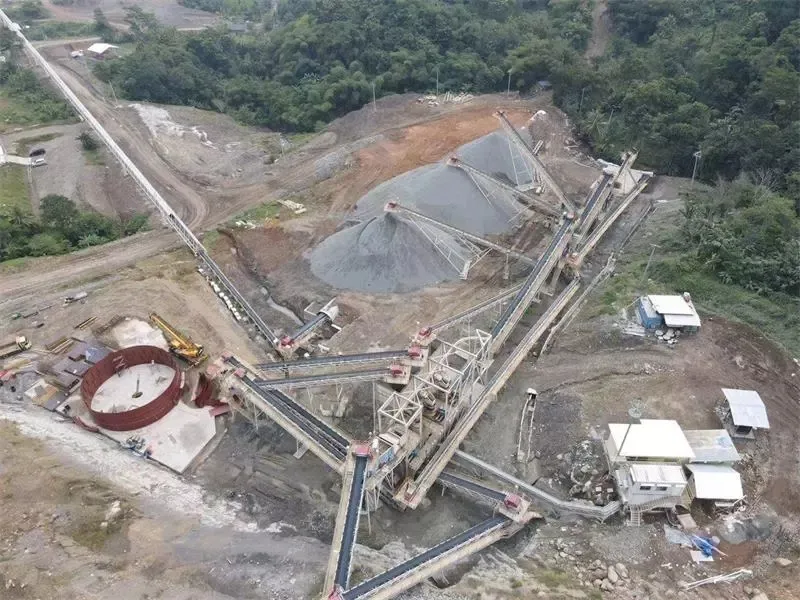
Choosing a crusher is not about finding the best machine on the market - it is about matching the machine to the rock. The same model that performs brilliantly on limestone can destroy its liners in weeks on abrasive granite. This guide explains the strengths of the three main crusher families and how to combine them into a circuit that runs efficiently for years.
Start with the material, not the machine
Three properties decide everything: hardness, abrasiveness and moisture. Hard, abrasive rocks such as granite, basalt, quartzite and river gravel call for compression crushing - jaw and cone crushers. Soft, non-abrasive materials such as limestone, gypsum and recycled concrete are ideal for impact crushing, which delivers better particle shape at lower cost. Wet, sticky feed with clay needs special attention to chute design, pre-screening and feed control regardless of crusher type.
Jaw crushers - the primary workhorse
The jaw crusher is almost always the first machine in the circuit. It accepts the largest feed size, tolerates slabby and irregular rock, and has a simple, robust structure that is easy to maintain in remote locations. Its product is suitable for secondary crushing but rarely meets commercial aggregate specifications directly, which is why jaws are usually followed by a cone or impact stage.
Cone crushers - precision in secondary and tertiary stages
Cone crushers take pre-crushed feed and produce a cubical, well-graded product with a precise closed-side setting. Modern cones use hydraulic adjustment and overload protection, so the operator can change the CSS in minutes and clear blockages safely. For hard, abrasive rock at high tonnage, a jaw-cone or cone-cone combination is the industry default.
Impact crushers - shaping, recycling and soft rock
Impact crushers (HSI and VSI) accelerate rock against blow bars or an anvil ring, producing excellent particle shape and a high proportion of fines. They dominate recycled concrete and asphalt applications and limestone quarries where cubicity sells. The trade-off is wear cost: on abrasive rock, blow bars and liners consume budgets quickly, so impact crushing should be chosen for the right materials, not everywhere.
Building an efficient circuit
- Match stage capacities - an oversized primary only creates a bottleneck elsewhere.
- Pre-screen the fines so each crusher works on rock that actually needs breaking.
- Use closed-circuit screening to hold the final product within specification.
- Plan the CSS of each stage so no single machine limits plant throughput.
- Consider hydraulic adjustment and automation from day one - they pay back in uptime and consistency.
Quick selection checklist
- Maximum feed size and required product size.
- Target capacity in tonnes per hour.
- Abrasiveness of the rock - it decides crusher type and liner metallurgy.
- Product shape requirements - cubic aggregate or base material.
- Mobility: stationary, semi-mobile or tracked.
- Long-term spare parts and wear parts supply.
If you share your feed analysis and target sizes with our engineers, we will propose a circuit configuration with matched equipment - from primary jaw to tertiary cone - and a wear parts plan for your rock. Contact NORDVIK for a free layout review.